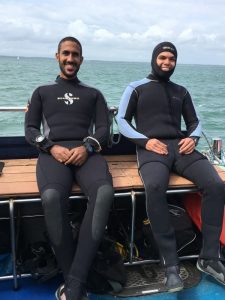
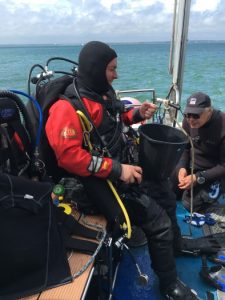
Mohamed and Ziad
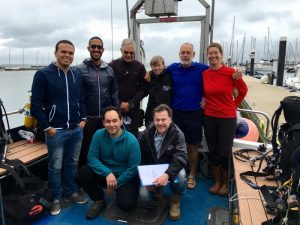
Bouldnor Cliff isn’t just important from a British perspective: it is a unique site that interests people from all over the world! The diving team included archaeologists from the Maritime Archaeology Trust and even two divers who’d traveled all the way from Egypt to help with the work and see the remains of the Mesolithic settlement. Ziad and Mohamed flew to Britain when volunteers were needed to join the Bouldnor Cliff survey, and came to help with the photogrammetry work around the site. They’ve done work all around the world, including in Montenegro, Lebanon, Egypt and Italy, but this was their first time diving in the U.K.
Ready for that renowned British summer, Ziad and Mohamed joined the team on the boat, keen to explore the famous site. Undeterred by the wind and rain of the first day (it is summer, after all), they were ready to get stuck in and brave the chilly Solent. Layered up and as prepared as can be for the colder climate they jumped in to get to work. The cold was no match for their enthusiasm and they worked hard, familiarising themselves with the site and the new conditions.
And what did they have to say after their first dive? Ziad had only one word: ‘challenge’!
Now used to the cold and the weather, they carried on diving on the site, contributing hundreds of photos to the photogrammetric survey, and taking footage on a GoPro. Their dedication is such that the skipper even poured warm water into their wetsuits before a dive! Inspired by Ziad’s one-word summary, Mohamed described the site as an ‘adventure’.
Ziad and Mohamed aren’t the only members of the #SaveBouldnor team from abroad – Sarah is from the United States, and Miguel is a PhD student from Lisbon, Portugal. Sarah works at the Maritime Archaeology Trust, and considers the site to be ‘groundbreaking’!
Miguel came to Bouldnor Cliff to gain experience in a new environment, and to improve his skills in 3D reconstruction and recording. Miguel described the site as ‘exciting’ and has contributed a lot of work to the photographic record.
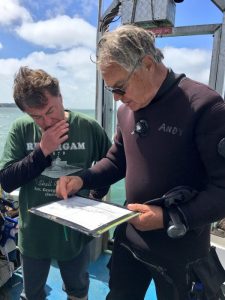
It’s not just maritime archaeologists who find Bouldnor Cliff fascinating – Andy has worked closely with the Trust for fifteen years. He finds the site ‘remarkable’, and, as a long-time diving enthusiast, is helping out on-site.
Bouldnor Cliff is a special site that is always turning up new information and fascinating artefacts. It has something of interest for people from all over the world, from different backgrounds, and this multi-national team has come together to work to save Bouldnor, and learn its secrets. Work like this is invaluable, and will contribute to the continuing record of Bouldnor Cliff, as the MAT monitor the site’s condition and explore new features.
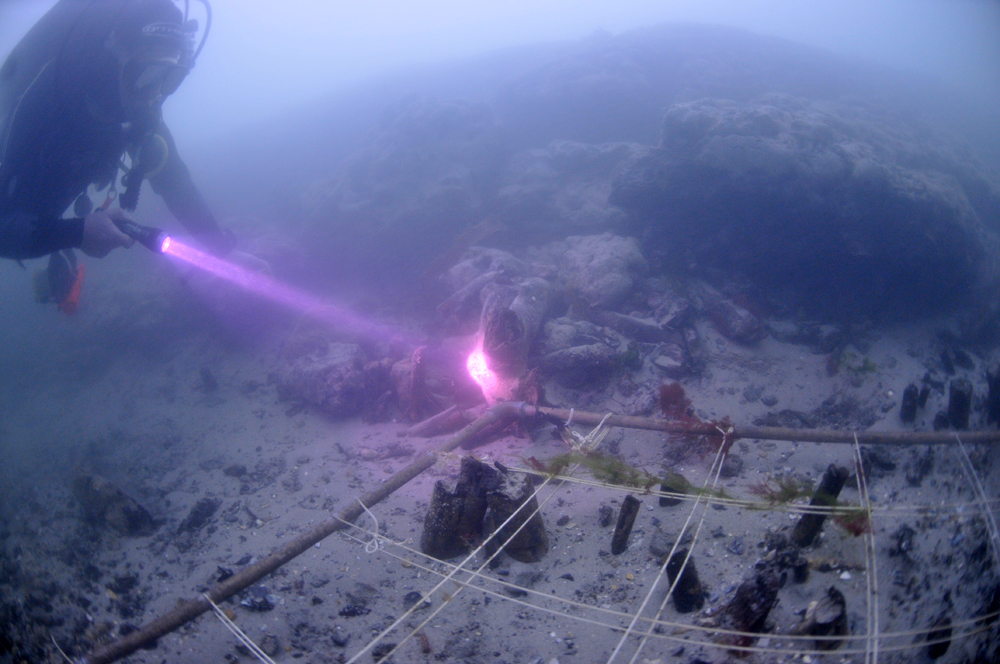
 Another day on Bouldnor Cliff reveals another exciting discovery. Garry Momber took part in the day’s first dive, and began to clear away some of the layer of mud covering the site. Underneath this mud he found a series of planks lying parallel to each other. Further dives will include more work on this potential platform, so the archaeologists can try to interpret the feature and its purpose. Yesterday, a diver found and recovered a small piece of flat, pointed timber that may turn out to be the end of a plank. Garry also recovered a small piece of wood, demonstrating the excellent preservation on this site. It is still possible to find organic material that is over 8,000 years old!
 Miguel, Ziad, and Mohamed are still hard at work on the photogrammetric work. Miguel has been acting as underwater photographer, taking pictures of Garry at work and using a 6m x 2m grid to take photos to create a photogrammetric model of the site and some of the exposed timbers. Ziad and Mohamed are doing similar work, both with and without photogrammetric targets. The divers are working hard to ensure they don’t damage any of the exposed timbers as they do their work, and are being careful where they use targets. In places where the timber is fragile, it may be better to work without them. Eventually, the hundreds of photos taken will be combined together. They will be used to create a 3D model of the Mesolithic site, which can be manipulated and interpreted, and used for further study.