Museum Week is an international online event that is running from 19th to 25th June 2017. Organised in collaboration with UNESCO, the Museum Week is a chance for heritage institutions across the world to share and talk about our passion for heritage with the public through social media. This year we are celebrating equality by dedicating the Museum Week to all women in the world.
The Maritime Archaeology Trust will be sharing with you our take on Museum Week. In collaboration with the Shipwreck Centre and Maritime Museum on the Isle of Wight we will be looking through their collections and bring you artefacts and histories that are linked in with the theme of the day.
The Friday theme during Museum Week is BOOKS!
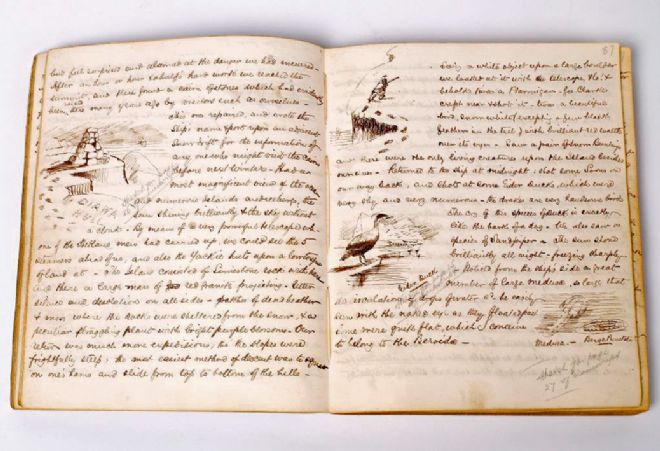
Logbook from the whaling ship Diana from hull, which accounts for a very tragic story. Source: http://www.mylearning.org/ships-log-of-the-diana/p-4300/
Or in our case, more accurately logbooks! A logbook or ship’s log is a record of important events that happened during the ship’s journey. This also includes management, operation and navigation of the ship.
The logbook was a key part of navigating a ship. Navigation is largely based on defining the latitude and longitude of the ship’s location. The longitude is the more difficult one to determine, as it requires the sailor to know the local time to determine what time zone they were travelling through, and as such determine their location by combining the ship’s latitude position. Medieval sailors were unable to determine the latitude-longitude completely accurately, due to the technology that was available to them at the time. As such the sailors heavily relied on the dead reckoning system. The dead reckoning principle works the following way. The sailor would start by taking a known or assumed position of the ship. Then the heading and the speed of the ship from this location would be measured, as well as the speed of the ocean currents, the leeward (downwind) drift, and how long the ship spent at each heading. Based on this information, the navigator could determine the course of the ship and how far the ship had travelled. This was noted down in the logbook, which was then used to as a reference to check the accuracy of the predicted dead reckoning.
A ship’s logbook holds a huge wealth of material for maritime archaeologists. Finding a ship’s logbook is like finding a gold mine. We can retrace the journey of the ship from the logbook and compare that to any remains we may have found. This is valuable when trying to determine the identity of a wreck for example. It also gives us a great insight into what life on board was like. For a great example is an extract from the logbook of the Halsewell. The Halsewell was a merchant ship based in the East India Company. There is a record in their logbook from 19th October 1781, where Lord Nelson (then Captain) recruits experienced sailors for the Navy, leaving the ship with only “foreigners and servants”.
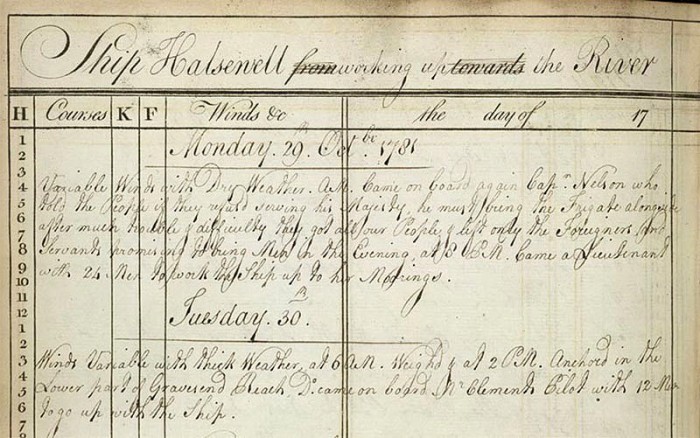
Captain Nelson recruiting experienced sailors from the Haslewell. Source: http://www.bl.uk/learning/timeline/item105531.html
The Shipwreck Centre also holds logbooks in their collection. An example can be seen here of the logbook from the HMS Victory which subsequently became the logbook of the HMS Duke of Wellington, the ship that replaced the HMS Victory as the Port Admiral flagship at Portsmouth between 1869 and 1891 (McKay 1987:9). Next time you visit the Shipwreck Centre and Maritime Museum on the Isle of Wight, try to spot the logbook which is on display next to old toothpaste and wood from the Mary Rose!
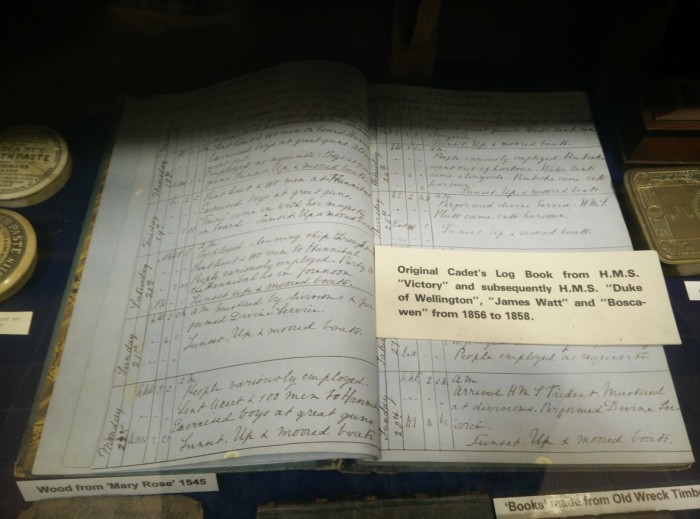
Cadet logbook of the HMS Victory on display in the Shipwreck Centre. Source: Shipwreck Centre and Maritime Museum


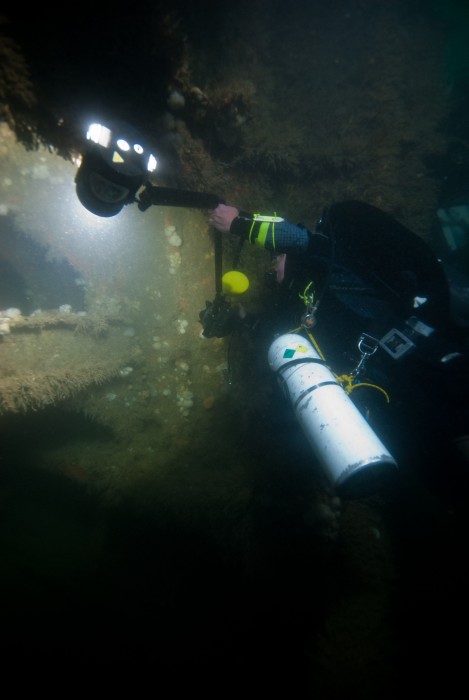
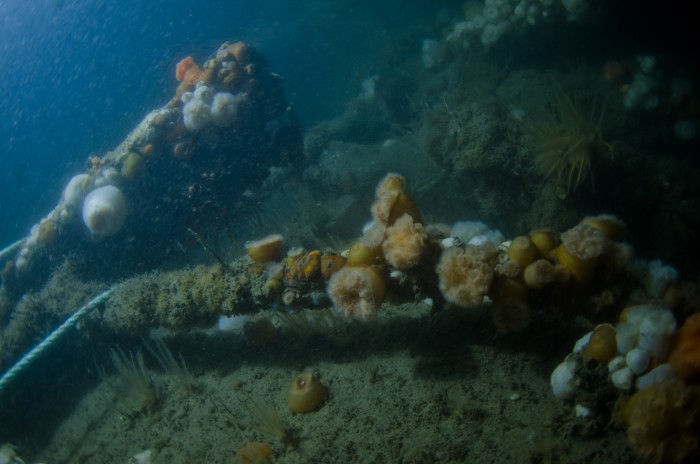
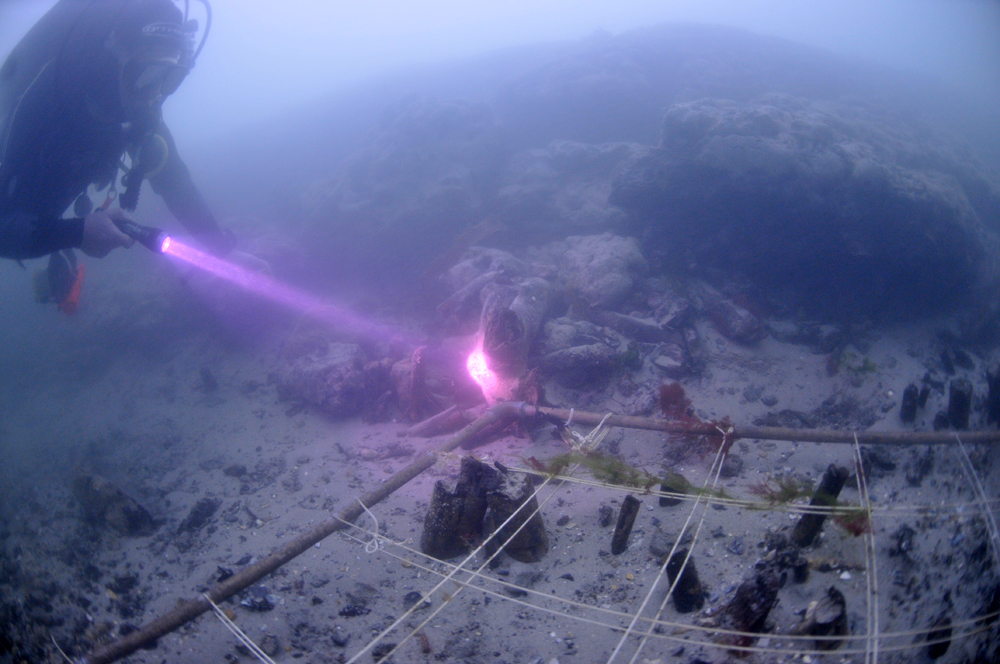
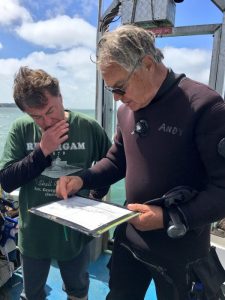 Another day on Bouldnor Cliff reveals another exciting discovery. Garry Momber took part in the day’s first dive, and began to clear away some of the layer of mud covering the site. Underneath this mud he found a series of planks lying parallel to each other. Further dives will include more work on this potential platform, so the archaeologists can try to interpret the feature and its purpose. Yesterday, a diver found and recovered a small piece of flat, pointed timber that may turn out to be the end of a plank. Garry also recovered a small piece of wood, demonstrating the excellent preservation on this site. It is still possible to find organic material that is over 8,000 years old!
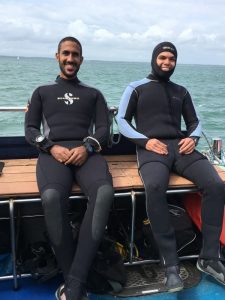
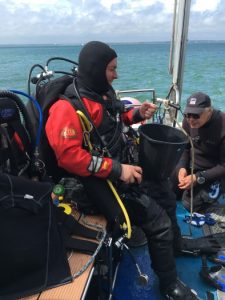 Miguel, Ziad, and Mohamed are still hard at work on the photogrammetric work. Miguel has been acting as underwater photographer, taking pictures of Garry at work and using a 6m x 2m grid to take photos to create a photogrammetric model of the site and some of the exposed timbers. Ziad and Mohamed are doing similar work, both with and without photogrammetric targets. The divers are working hard to ensure they don’t damage any of the exposed timbers as they do their work, and are being careful where they use targets. In places where the timber is fragile, it may be better to work without them. Eventually, the hundreds of photos taken will be combined together. They will be used to create a 3D model of the Mesolithic site, which can be manipulated and interpreted, and used for further study.